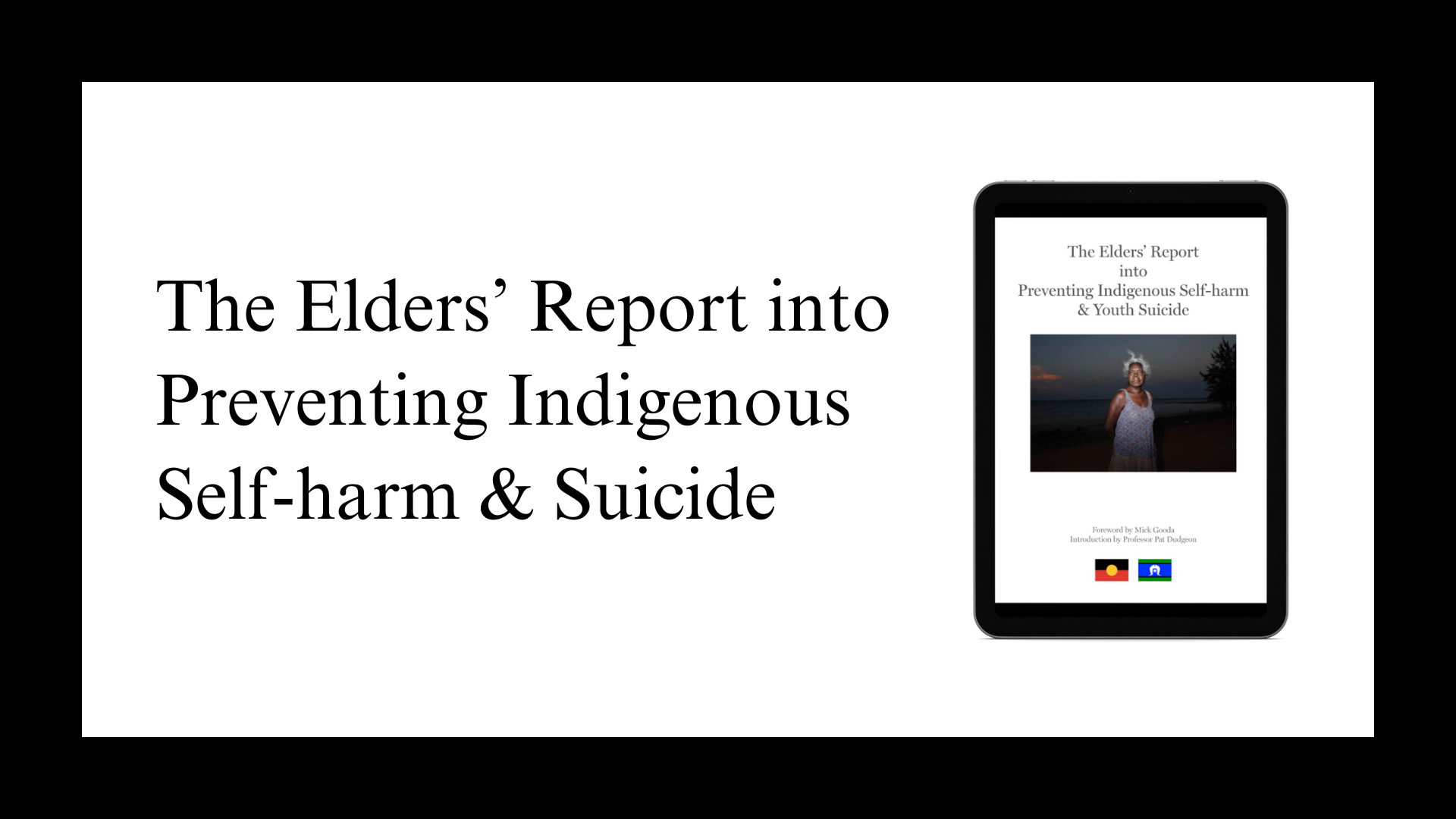
The report is a transcription of interviews held with 31 Elders and Community representatives from over 17 communities. Each speaker was asked two primary questions: why is self-harm and suicide happening? what is the solution? In response to the first question there was a high level of agreement between the speakers about the role culture and loss of cultural connection plays in making young people vulnerable to self-harm.
Acknowledgements
We pay respects to the traditional lands across the continent and islands that these interviews took place on. We acknowledge and pay our gratitude to the work of Mick Gooda (forward by), Professor Pat Dudgeon (Introduction author & Director of CBPATSISP), the late Max Dulumunmun Harrison (Report summary) and all the Elders who shared their hearts and minds in the interviews.
“In the only report entirely seeking solutions from within Indigenous communities, the Elders’ Report into Preventing Indigenous Self-harm and Youth Suicide sought the experience of elders on what can be done to stop the deaths.” (Source: Aboriginal Art Directory Website)
Through a series of strong and sometimes poignant interviews with Aboriginal elders from around Australia, Culture is Life (led by late Uncle Max Dulumunmun Harrison, Yuin Elder) the Elders’ Report into Preventing Indigenous Self-harm and Youth Suicide brings to light the high suicide rate among Indigenous Australian youth.
The Reality
- Indigenous youth suicide in Australia has now risen to become one of the highest in the world.
- In the Kimberley alone there is one attempted Indigenous suicide per week.
- The percentage of Indigenous suicide has increased from 5% of total suicide in 1991 to 50% in 2010.
- The most dramatic increase was in youth aged 10 – 24, where the percentage of Indigenous youth suicide increased from 10% in 1991 to 80% in 2010.
- Over a 20 year period the incidence of youth suicide in these communities went from being an extremely rare phenomenon, to one where the rate of Indigenous youth suicide is now the highest in the world.
The Australian Bureau of Statistics states for young Aboriginal men, the rate is 4 times higher than their non-Indigenous counterparts, whilst for young Aboriginal women the rate is five times higherIn some remote communities in the Kimberley, spates of suicide have reached 100 times the national suicide average. In the Australian Government’s own report, Gone Too Soon, into youth suicide in the NT, published in 2012 states: “The suicide rate for Indigenous Territorians is particularly disturbing, with 75 per cent of suicides of children from 2007 to 2011 in the Territory being Aboriginal.
Elders Report Refresh
In 2012, Culture is Life conducted research with Elders from around Australia to explore the reasons why self-harm and suicide are happening among Indigenous youth and to identify solutions.
Culture is Life has approached EY to conduct a “refresh” of the Elders’ report.
This process will explore these issues with some Indigenous young people, as well as some Elders and practitioners.
The first half of the project has taken place in Gumbaynggirr country NSW and the data is below, with the second stage is occurring in Feb 2020 in Broome/Derby WA. This process included four staff members and fifteen participants.
Indigenous Suicide Prevention Forum 2024
On the 5th of March 2024, a panelist of local Elders and Elders that contributed to the report were invited to speak at the Indigenous Suicide Prevention Forum on Bunurong/BoonWurrung Country in Albert Park, Melbourne.
Culture is Life hoped this to be an opportunity for the knowledge and experience of Elders to he heard in the forum’s purpose on addressing self-harm and suicide in Aboriginal and Torres Strait Islander communities across Australia.
Elders had the opportunity to speak to potential causes of increasing rates of self-harm and youth suicide and what solutions should be implemented to address these causes. In addition to discussing the outcomes and progress made since the publication of the Elders’ Report into Preventing Indigenous Self-harm & Youth Suicide.
Fullaship Program alumni Manny Williams (Kalkadoon, Pitta Pitta and Bundjalung) moderated a yarn with a panel of Elders at the Indigenous Suicide Prevention Forum 2024 on BoonWurrung Country. Professor Gracelyn Smallwood (Forum Elder), Professor Pat Dudgeon (Culture is Life Co-Chair) , Aunty Stephanie Armstrong (Culture is Life Senior consultant) and Uncle Keith Boney shared their perspectives and lived experience on suicide prevention.
Elders were asked questions from the Elders Report into Suicide Prevention & Self Harm (2018) including why are we experiencing high rates or suicide in our communities and what are the solutions?
The panel shared strong themes are the importance of Country for healing. Prof Pat A question from the audience was “How do we heal a broken spirit?” Aunty Steff responded with the importance of connection to Country and mob. And proposed for the delegates ‘I wonder if we’ve forgotten about how to listen to Country? Ild like to see more work on that.’
‘Being on Country is the best for our own healing. And to be with Elders and respected people. That’s our journey to healing’. Prof. Gracelyn Smallwood.
“The youth are our trailblazers. We have incredible programs and examples of this like Culture is Life’s programs. I think our youth will be confident, culturally grounded and community oriented. I’m feeling optimistic about the future.’ Prof Pat Dudgeon.
“Get yourself well, coz it’s a marathon. We just opened the doors and yous have 40 more years of work.’ Aunty Steff Armstrong
Aunty Pat reflected as a Bardi woman living on Noongar Country the places she finds healing, a reminder we have access to the healing powers of Country everywhere.
Key Findings
Some key findings from the report include:
“Most of the Elders who are 70+, especially those in the Kimberley, are people who have been able to navigate their way through the mainstream world and their own cultural world. I think that lived experience and those journeys are lessons that need to be passed onto young people. Elders and young people have an important relationship to bring to fruition.” – Dr Anne Poelina, Broome, WA
“You can empower our people by supporting them and listening to them, by sitting down with them and talking to them face-to-face, and that’s not happening. Fair enough, we have got Government workers doing field visits and all of that, but it isn’t enough. You’ve got to spend more time with the people and listen to their cry of help. That’s not happening. It’s not being heard and acted upon back in Canberra.” – Lorna Hudson OAM, Derby, WA
“Aboriginal people need to be involved in solving our own problems. Bringing outsiders into the Kimberley will not create succession, the legacies of change that we need. Outsiders bring in quick fixes, providing there is a level of government funding and resourcing. There are a lot of people running around trying to do good, but it doesn’t create inter-generational change. We want to up-skill our own people.” – Wayne Bergmann, Kimberley, WA
“Our suicide rate is high. Our Elders are finding it hard. The Government is cutting the services that we need to keep. Culture is important. That’s when our young people know who they are. On the Western side they lose their way. The cultural way, they don’t need their mobiles and gadgets. They can start hunting again, feeding and looking after their families. They can sit down, share culture and food and be with the Elders again.” – Estelle Bowen, Hopevale, QLD